
Back
Present
Facts for Kids
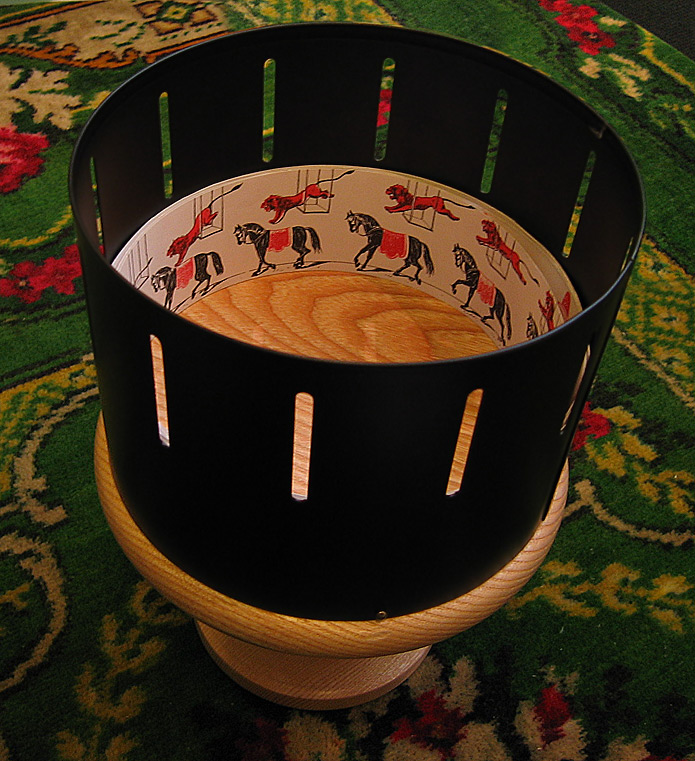
A zoetrope is a simple toy that makes still pictures look like they move, helping people see how steady drawings can become moving pictures.

Explore the internet with AstroSafe
Search safely, manage screen time, and remove ads and inappropriate content with the AstroSafe Browser.
Download
Did you know?
🌀 A zoetrope is a cylinder that spins with a sequence of drawings or photos to create the illusion of motion.
🗓️ It became popular after 1833.
🎁 The definitive, replaceable-film zoetrope was sold as a toy by Milton Bradley in 1866.
🎬 The 1999 film House on Haunted Hill features a man-sized zoetrope chamber.
🎥 A 3D zoetrope by Sehsucht, Berlin was used in the 2012 MTV Europe Music Awards opener.
📺 BBC Two unveiled a zoetrope image as one of its idents in 2007.
Show Less

Become a Creator with DIY.org
A safe online space featuring over 5,000 challenges to create, explore and learn in.
Learn more
How It Works
A zoetrope is a hollow cylinder with thin vertical openings called slits around the top edge. Inside the cylinder a long strip of drawings or photos is glued so each picture sits next to the next.
When the cylinder spins and you look through one of the slits, you see each picture for a short moment. The slits block your view between pictures, so your eye does not see the blur. Spin the drum faster and the images flash more quickly, making the motion look smoother. Many zoetropes have a low open base and the slits near the top where you look in.
When the cylinder spins and you look through one of the slits, you see each picture for a short moment. The slits block your view between pictures, so your eye does not see the blur. Spin the drum faster and the images flash more quickly, making the motion look smoother. Many zoetropes have a low open base and the slits near the top where you look in.
Read Less
Introduction
A zoetrope is a simple machine that makes still pictures look like they are moving. It belongs to a group of devices people used before movies were invented. The idea is to show a series of drawings or photos that each show a little step of an action, like a person lifting an arm. When these pictures pass by quickly, your eye and brain join the steps together and you see motion.
The zoetrope grew from earlier spinning picture toys in the 1800s. It became a very popular toy when a company sold versions with replaceable picture strips in 1866.
The zoetrope grew from earlier spinning picture toys in the 1800s. It became a very popular toy when a company sold versions with replaceable picture strips in 1866.
Read Less
Maxwell’s Improved Zoetrope
A few years after Lincoln, scientist James Clerk Maxwell made a clever change in 1868. Instead of looking through slits, Maxwell used small concave lenses set around the inside of a spinning cylinder. These lenses bent the light so each picture seemed to sit at the center of the cylinder, making the moving image look sharper and steadier.
Maxwell used his device mostly to show scientific ideas, like vibrating strings and swirling air rings, so people could see how these motions worked. His improved zoetrope was written about in a science magazine in 1869, and the original machine is now kept in a museum in Cambridge.
Maxwell used his device mostly to show scientific ideas, like vibrating strings and swirling air rings, so people could see how these motions worked. His improved zoetrope was written about in a science magazine in 1869, and the original machine is now kept in a museum in Cambridge.
Read Less
Invention – Stampfer and Horner
In 1833 a scientist named Simon Stampfer helped invent the stroboscopic disc, a flat spinning disc that made pictures seem to move. He also suggested putting those images on a cylinder or a looped strip so they could be viewed differently.
Shortly after, William George Horner made a cylinder idea and published how it worked in January 1834. He called his machine the Dædaleum, a name that comes from the clever craftsman Daedalus in stories. Horner’s drum had the viewing slits placed between the pictures, which was a little different from later designs, and he planned to work with an optician to make and sell it.
Shortly after, William George Horner made a cylinder idea and published how it worked in January 1834. He called his machine the Dædaleum, a name that comes from the clever craftsman Daedalus in stories. Horner’s drum had the viewing slits placed between the pictures, which was a little different from later designs, and he planned to work with an optician to make and sell it.
Read Less
Earlier rotating devices with images
Long before the zoetrope, people made objects that used spinning pictures. Archeologists found a clay bowl from what is now Iran with a row of small pictures that could form a scene when turned. This shows that people have tried to make moving pictures for thousands of years.
Other early objects include a Chinese lamp with a circular band of scenes and a 1600s description by John Bate of a toy that turned when it warmed. In these examples, whether they were meant as true animations is unclear, because lighting and speed also affect what you see.
Other early objects include a Chinese lamp with a circular band of scenes and a 1600s description by John Bate of a toy that turned when it warmed. In these examples, whether they were meant as true animations is unclear, because lighting and speed also affect what you see.
Read Less
Lincoln and Milton Bradley's Zoetrope
When a young student named William Ensign Lincoln built his version of the zoetrope in 1865, he made something people could actually use to see pictures move. Lincoln’s machine had a round base with a strip of drawings and small slits above each picture. A viewer would look through the slits while the base turned, and the drawings looked like a short animation. Lincoln sent a model to the toy maker Milton Bradley, and by late 1866 Bradley was advertising sets people could buy.
Lincoln applied for a patent in 1866 and it was granted in 1867 in the United States and in Europe soon after. Milton Bradley sold sets of twelve replaceable picture strips so children and families could try many short scenes at home. Other publishers in Britain made similar strips under license, helping the zoetrope become a popular toy.
Lincoln applied for a patent in 1866 and it was granted in 1867 in the United States and in Europe soon after. Milton Bradley sold sets of twelve replaceable picture strips so children and families could try many short scenes at home. Other publishers in Britain made similar strips under license, helping the zoetrope become a popular toy.
Read Less
Linear Zoetropes and Subway Shows in Japan
A linear zoetrope is a cousin of the spinning one. Instead of pictures on a circle, it uses many images painted in a long row. A small slit or window sits in front of each picture. When a person or a train moves past at the right speed, the slices of images line up and the pictures appear to move.
In Japan, artists and designers liked to use this idea in stations and public places. They arranged long sequences of images along walls or platforms so that passing trains made the pictures come alive. These displays turned ordinary journeys into little moving-picture shows that surprised and delighted riders.
In Japan, artists and designers liked to use this idea in stations and public places. They arranged long sequences of images along walls or platforms so that passing trains made the pictures come alive. These displays turned ordinary journeys into little moving-picture shows that surprised and delighted riders.
Read Less
Masstransiscope and Later Subway Zoetropes
One famous example of a subway zoetrope is Bill Brand’s Masstransiscope, installed in New York City in 1980. Brand painted 228 panels on the wall of a subway tunnel and put slits in front of them. As a train passed, riders looking out the window saw a hand-painted motion picture—like a small movie framed by the window slits.
The Masstransiscope fell into disrepair but was lovingly restored in 2008. Its success showed that subway walls could become public art that moves. Since then, other artists have created similar tunnel and station animations, using slits, panels, or windows so commuters can catch a brief, surprising scene during their ride.
The Masstransiscope fell into disrepair but was lovingly restored in 2008. Its success showed that subway walls could become public art that moves. Since then, other artists have created similar tunnel and station animations, using slits, panels, or windows so commuters can catch a brief, surprising scene during their ride.
Read Less
How Zoetropes Are Used Today and Why They Matter
A zoetrope still appears in many places today. Artists and designers build big, looping zoetropes for public art and advertising. For example, in 2001 Joshua Spodek helped create a huge, lined-up zoetrope inside an Atlanta subway tunnel that was almost 1,000 feet long and shown with lights so people could watch a moving picture about 20 seconds long as trains passed. Smaller versions light up museums and stores, and schools use them for hands-on lessons about how motion works.
These machines also shaped modern movies and animation. The praxinoscope changed the zoetrope by using mirrors to make images clearer, while the flip book gave people a tiny, pocket way to make motion. Photographer Muybridge used sequences of pictures and an early machine called the zoopraxiscope to study movement, which helped invent cinema. Today, zoetropes teach science, inspire artists, and remind people how simple tricks of the eye can create the magic of moving pictures.
These machines also shaped modern movies and animation. The praxinoscope changed the zoetrope by using mirrors to make images clearer, while the flip book gave people a tiny, pocket way to make motion. Photographer Muybridge used sequences of pictures and an early machine called the zoopraxiscope to study movement, which helped invent cinema. Today, zoetropes teach science, inspire artists, and remind people how simple tricks of the eye can create the magic of moving pictures.
Read Less
Try your luck with the Zoetrope Quiz.
Try this Zoetrope quiz and see how many you score!
Q1
Question 1 of 5
Next
Explore More