
Back
Present
Facts for Kids
Partial differential equations (PDEs) are mathematical equations that involve multiple variables and their partial derivatives, widely used in physics to model complex systems and phenomena.

Explore the internet with AstroSafe
Search safely, manage screen time, and remove ads and inappropriate content with the AstroSafe Browser.
Download

Become a Creator with DIY.org
A safe online space featuring over 5,000 challenges to create, explore and learn in.
Learn more
Overview
Partial Differential Equations (PDEs) are like powerful math tools that help us understand how things change! 🌊
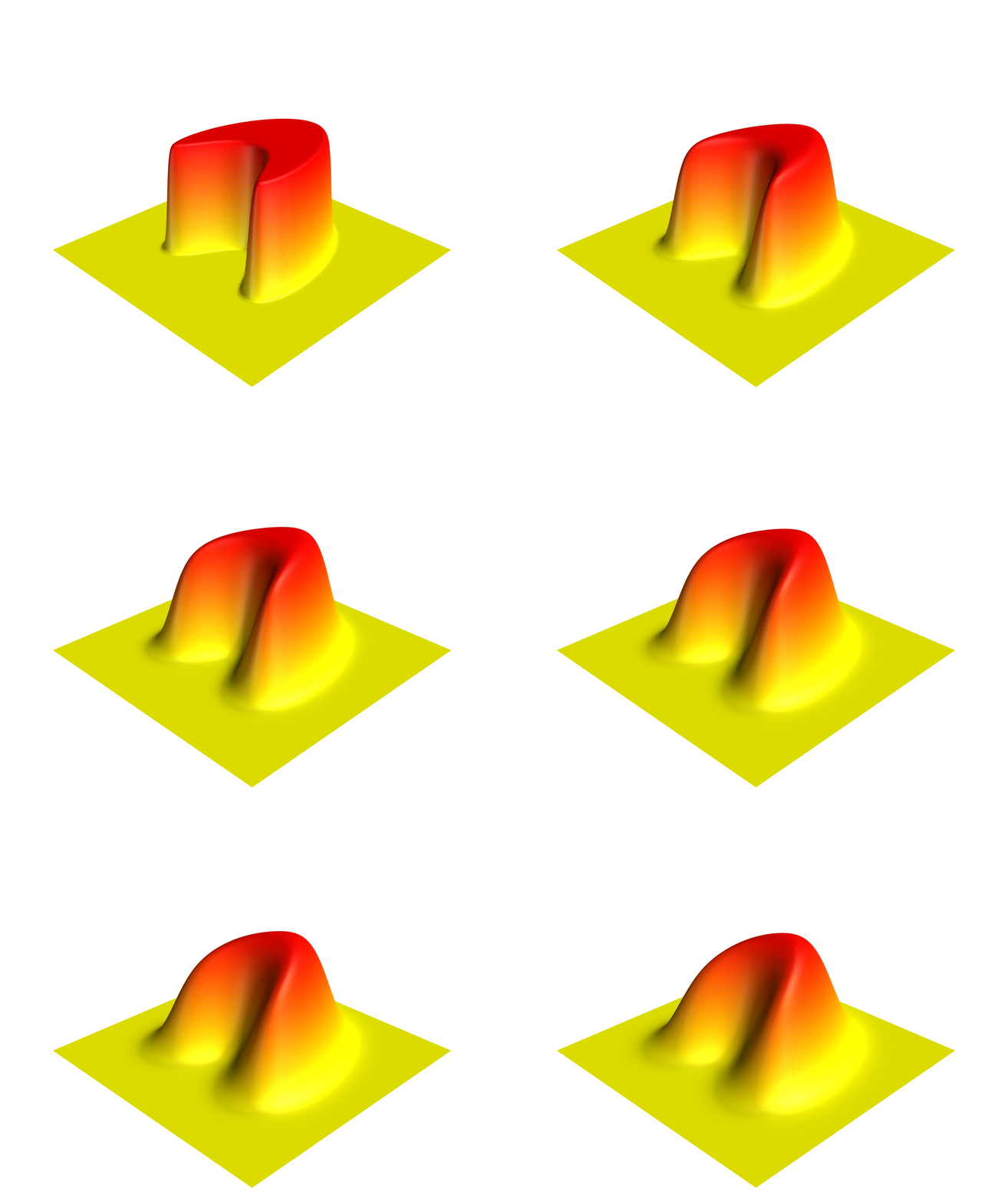
They involve functions with more than one variable, like time and space. For example, they can describe how heat spreads in a room or how waves move in water. 🌊
In simple terms, PDEs help scientists and engineers find out what happens in different situations, making them super important for many fields, including physics, engineering, and even finance. Understanding PDEs helps us solve real-world problems and discover new things in our world! 🎉
They involve functions with more than one variable, like time and space. For example, they can describe how heat spreads in a room or how waves move in water. 🌊
In simple terms, PDEs help scientists and engineers find out what happens in different situations, making them super important for many fields, including physics, engineering, and even finance. Understanding PDEs helps us solve real-world problems and discover new things in our world! 🎉
Read Less
Qualitative Analysis
Qualitative analysis helps scientists understand the behavior of solutions to PDEs without solving them completely! 🔍
It looks at things like stability and patterns. For instance, scientists can figure out if a system will remain steady or change over time. 🌪
️ They also use phase diagrams, which show how different solutions change based on parameters. 📊
This analysis is like studying the "personality" of mathematical problems to predict how they will act! Understanding these behaviors is vital for creating effective plans in science and engineering! 🚀
It looks at things like stability and patterns. For instance, scientists can figure out if a system will remain steady or change over time. 🌪
️ They also use phase diagrams, which show how different solutions change based on parameters. 📊
This analysis is like studying the "personality" of mathematical problems to predict how they will act! Understanding these behaviors is vital for creating effective plans in science and engineering! 🚀
Read Less
Analytical Techniques
Analytical techniques are fancy ways to solve PDEs without computers! 🧮
One method is the Separation of Variables, which helps break complex problems into smaller problems. 🌟
Another technique is Transform Methods, which uses special functions like Fourier or Laplace transforms to make solving PDEs easier. 🌈
These techniques can give exact answers to many problems, like predicting how heat flows in a metal rod! 🔥
Understanding these techniques helps scientists know when to rely on calculations and when to use computers!
One method is the Separation of Variables, which helps break complex problems into smaller problems. 🌟
Another technique is Transform Methods, which uses special functions like Fourier or Laplace transforms to make solving PDEs easier. 🌈
These techniques can give exact answers to many problems, like predicting how heat flows in a metal rod! 🔥
Understanding these techniques helps scientists know when to rely on calculations and when to use computers!
Read Less
Historical Development
PDEs have a long history, starting in the late 18th century! 📜
One of the earliest contributors was French mathematician Jean le Rond d'Alembert, who studied wave equations. Later, in the 19th century, scientists like Joseph Fourier helped develop solutions for heat equations. 🌡
️ The modern development of PDEs really took off in the 20th century with mathematicians like David Hilbert. Understanding these equations has allowed us to explain many fascinating phenomena, like how the weather changes! 🌤
️ Today, mathematicians and scientists continue to learn more about PDEs and how to use them in new and exciting ways! 🚀
One of the earliest contributors was French mathematician Jean le Rond d'Alembert, who studied wave equations. Later, in the 19th century, scientists like Joseph Fourier helped develop solutions for heat equations. 🌡
️ The modern development of PDEs really took off in the 20th century with mathematicians like David Hilbert. Understanding these equations has allowed us to explain many fascinating phenomena, like how the weather changes! 🌤
️ Today, mathematicians and scientists continue to learn more about PDEs and how to use them in new and exciting ways! 🚀
Read Less
Current Research Trends
Today, researchers are exploring exciting new ideas in PDEs! 🔭
One hot topic is using artificial intelligence (AI) to find solutions faster. 🤖
Scientists are also looking at how to better model real-world problems, like climate change and fluid dynamics. 🌍🔄 Additionally, they are studying wave propagation in new materials, which could lead to innovative technologies! 🌟
New numerical methods and computational power allow researchers to take on more complex problems than ever before. So, the future of PDEs is full of promise and discoveries waiting to happen! 🌈
One hot topic is using artificial intelligence (AI) to find solutions faster. 🤖
Scientists are also looking at how to better model real-world problems, like climate change and fluid dynamics. 🌍🔄 Additionally, they are studying wave propagation in new materials, which could lead to innovative technologies! 🌟
New numerical methods and computational power allow researchers to take on more complex problems than ever before. So, the future of PDEs is full of promise and discoveries waiting to happen! 🌈
Read Less
Boundary and Initial Conditions
Boundary and initial conditions are super important when working with PDEs! 🏞
️ They're like rules that help scientists set the scene for a problem. Boundary conditions tell us how things behave at the edges of an area, like the temperature of a wall! 🌡
️ Initial conditions are the starting points of a problem, giving the situation a place to begin. For instance, knowing the temperature of a hot object helps predict how it cools down. 📉
These conditions help make sure our answers to PDEs are accurate and realistic, making them essential for solving equations! 💡
️ They're like rules that help scientists set the scene for a problem. Boundary conditions tell us how things behave at the edges of an area, like the temperature of a wall! 🌡
️ Initial conditions are the starting points of a problem, giving the situation a place to begin. For instance, knowing the temperature of a hot object helps predict how it cools down. 📉
These conditions help make sure our answers to PDEs are accurate and realistic, making them essential for solving equations! 💡
Read Less
Numerical Methods for Solving PDEs
Sometimes PDEs are too tricky to solve exactly, so scientists use *numerical methods*! 🖥
️ These methods turn PDEs into simpler math problems that computers can solve! One popular method is called the Finite Difference Method (FDM). It breaks down equations into small parts and uses numbers to find solutions. Another method is called the Finite Element Method (FEM), which helps solve complicated shapes and structures! 🔷
These numerical methods are like magic wands for scientists, allowing them to find answers for confusing equations! ✨
️ These methods turn PDEs into simpler math problems that computers can solve! One popular method is called the Finite Difference Method (FDM). It breaks down equations into small parts and uses numbers to find solutions. Another method is called the Finite Element Method (FEM), which helps solve complicated shapes and structures! 🔷
These numerical methods are like magic wands for scientists, allowing them to find answers for confusing equations! ✨
Read Less
Applications in Science and Engineering
PDEs are used in many exciting fields! 🔍
For example, in physics, they help us understand how waves move, like ocean waves 🌊 or sound waves 🎶. In engineering, PDEs are essential for designing buildings. They help ensure that structures can withstand forces like wind or earthquakes! 🌪
️ In medicine, PDEs are used to model the spread of diseases 🦠, which helps us find ways to stop them. From predicting the weather to creating new technologies, PDEs play a vital role in making our world a better place! 🌍
For example, in physics, they help us understand how waves move, like ocean waves 🌊 or sound waves 🎶. In engineering, PDEs are essential for designing buildings. They help ensure that structures can withstand forces like wind or earthquakes! 🌪
️ In medicine, PDEs are used to model the spread of diseases 🦠, which helps us find ways to stop them. From predicting the weather to creating new technologies, PDEs play a vital role in making our world a better place! 🌍
Read Less
Types of Partial Differential Equations
There are three main types of PDEs! 😊
The first is elliptic equations, which describe systems in a stable state, like the temperature in a room. The second type is parabolic equations, which often deal with time, like how heat spreads over time. 🌡
️ Finally, we have hyperbolic equations, which describe waves, like sound traveling through the air! 🎶
Each type is special, and they help scientists solve different types of problems in physics and engineering. Understanding these types helps us figure out how to use them in real-world scenarios! 🌎
The first is elliptic equations, which describe systems in a stable state, like the temperature in a room. The second type is parabolic equations, which often deal with time, like how heat spreads over time. 🌡
️ Finally, we have hyperbolic equations, which describe waves, like sound traveling through the air! 🎶
Each type is special, and they help scientists solve different types of problems in physics and engineering. Understanding these types helps us figure out how to use them in real-world scenarios! 🌎
Read Less
Try your luck with the Partial Differential Equations Quiz.
Try this Partial Differential Equations quiz and see how many you score!
Q1
Question 1 of 10
Next
Explore More