
Back
Present
Facts for Kids
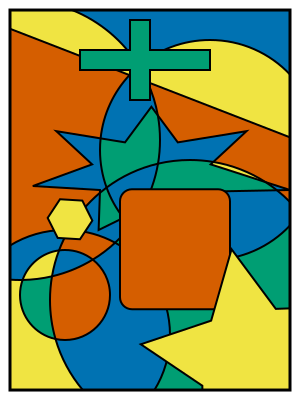
The Four Color Theorem states that no more than four colors are needed to color the regions of any map so that no two adjacent regions share the same color.

Explore the internet with AstroSafe
Search safely, manage screen time, and remove ads and inappropriate content with the AstroSafe Browser.
Download

Become a Creator with DIY.org
A safe online space featuring over 5,000 challenges to create, explore and learn in.
Learn more
Overview
The Four Color Theorem is a fantastic idea in mathematics! 📚✨ It tells us that we can color any map using just four colors, and we can do it in such a way that no two neighboring areas have the same color. For example, if you draw a map of four countries, you won’t need more than four crayons to color them differently! 🎨
The theorem was first proved in 1976 by mathematicians Kenneth Appel and Wolfgang Haken. They used a computer to help check many different cases to make sure the theorem is correct! 🌍
The theorem was first proved in 1976 by mathematicians Kenneth Appel and Wolfgang Haken. They used a computer to help check many different cases to make sure the theorem is correct! 🌍
Read Less
Computational Approaches
Computers are super helpful in solving complex problems! 🖥
️ The Four Color Theorem was proved with the help of computers in 1976. Mathematicians Kenneth Appel and Wolfgang Haken used a computer program to check thousands of map configurations. 🤖
They looked at different ways the maps could be colored and checked if any needed more than four colors. This proved that four colors are enough for any map! Since then, computers have become essential for math proofs, allowing mathematicians to solve problems that were too big for humans to handle alone! 🧩
️ The Four Color Theorem was proved with the help of computers in 1976. Mathematicians Kenneth Appel and Wolfgang Haken used a computer program to check thousands of map configurations. 🤖
They looked at different ways the maps could be colored and checked if any needed more than four colors. This proved that four colors are enough for any map! Since then, computers have become essential for math proofs, allowing mathematicians to solve problems that were too big for humans to handle alone! 🧩
Read Less
Famous Cases and Examples
Several fun examples highlight the Four Color Theorem! 🗺
️ One famous case is the map of the United States, where states are painted so no neighboring states use the same color! Maryland, Virginia, and West Virginia can be colored using just four different shades. 🌈
Another classic example is Europe, where countries share borders and can also be colored with only four colors! A real-life application is board games—like Risk—where players use different colors for territories. These examples show us that math is not just numbers; it’s about making sense of colors and the world we live in! 🎉
️ One famous case is the map of the United States, where states are painted so no neighboring states use the same color! Maryland, Virginia, and West Virginia can be colored using just four different shades. 🌈
Another classic example is Europe, where countries share borders and can also be colored with only four colors! A real-life application is board games—like Risk—where players use different colors for territories. These examples show us that math is not just numbers; it’s about making sense of colors and the world we live in! 🎉
Read Less
Significance in Mathematics
The Four Color Theorem is important because it changed how mathematicians think about problems! 🌟
It was one of the first major theorems proved with the help of a computer, showing that technology plays a big role in mathematics today. 📅
This theorem is not just about maps; it impacts various fields such as computer graphics, scheduling, and even biology! The theorem encourages people to investigate patterns and find solutions in creative ways. It helps us see how mathematics connects with the world we live in—through maps, colors, and much more! 🌈
It was one of the first major theorems proved with the help of a computer, showing that technology plays a big role in mathematics today. 📅
This theorem is not just about maps; it impacts various fields such as computer graphics, scheduling, and even biology! The theorem encourages people to investigate patterns and find solutions in creative ways. It helps us see how mathematics connects with the world we live in—through maps, colors, and much more! 🌈
Read Less
Applications in Graph Theory
Graph theory is a field of mathematics that studies how things connect! 🌐
The Four Color Theorem fits perfectly into graph theory. Imagine each area of a map as a point (called a vertex) and the borders between them as lines (called edges). The theorem tells us that we can color these points with just four colors. This idea helps in many areas, like scheduling tasks, making maps, and organizing information! 📊
For example, when friends want to plan events without overlapping times, they can use ideas from graph theory to make sure everyone gets a turn! 🎉
The Four Color Theorem fits perfectly into graph theory. Imagine each area of a map as a point (called a vertex) and the borders between them as lines (called edges). The theorem tells us that we can color these points with just four colors. This idea helps in many areas, like scheduling tasks, making maps, and organizing information! 📊
For example, when friends want to plan events without overlapping times, they can use ideas from graph theory to make sure everyone gets a turn! 🎉
Read Less
Mathematical Statement and Proof
The Four Color Theorem states that four colors are enough to color any map so that neighboring regions never share the same color. 🎨
The proof is quite complicated, as it involves checking many different arrangements of maps! Appel and Haken created a computer program to help with this task. 🤖
They showed 1,936 different configurations, confirming that four colors always worked. The proof took a long time, but it made history as one of the first major proofs using a computer. This was a big deal because it opened up new ways to prove math ideas using technology! 💻
The proof is quite complicated, as it involves checking many different arrangements of maps! Appel and Haken created a computer program to help with this task. 🤖
They showed 1,936 different configurations, confirming that four colors always worked. The proof took a long time, but it made history as one of the first major proofs using a computer. This was a big deal because it opened up new ways to prove math ideas using technology! 💻
Read Less
Related Theorems and Conjectures
There are several exciting ideas related to the Four Color Theorem! 🌐
One important one is the Five Color Theorem, which says you could use five colors to color any map, but this is a no-brainer since it means four colors also work! 😄
Another idea to explore is the idea of mathematically coloring graphs, which is a topic in graph theory. There are also other interesting proofs, like the Heawood Conjecture, which deals with surfaces like doughnuts. 🍩
These ideas help mathematicians understand more about coloring, mapping, and even puzzles in our everyday lives! 🎉
One important one is the Five Color Theorem, which says you could use five colors to color any map, but this is a no-brainer since it means four colors also work! 😄
Another idea to explore is the idea of mathematically coloring graphs, which is a topic in graph theory. There are also other interesting proofs, like the Heawood Conjecture, which deals with surfaces like doughnuts. 🍩
These ideas help mathematicians understand more about coloring, mapping, and even puzzles in our everyday lives! 🎉
Read Less
History of the Four Color Theorem
The Four Color Theorem has a fascinating history! It started with a question from a British mathematician named Francis Guthrie in 1852. He wanted to know if it was possible to color a map using only four colors. 🔍
Over the years, many mathematicians tried to solve this puzzle. It wasn't until 1976 that Appel and Haken proved it, using a computer to check all the cases needed! In history, some earlier attempts weren’t successful, but they laid the groundwork. So, the four-color puzzle turned into an exciting challenge for mathematicians across the world! 🌐
Over the years, many mathematicians tried to solve this puzzle. It wasn't until 1976 that Appel and Haken proved it, using a computer to check all the cases needed! In history, some earlier attempts weren’t successful, but they laid the groundwork. So, the four-color puzzle turned into an exciting challenge for mathematicians across the world! 🌐
Read Less
Geographic Information Systems (GIS)
Geographic Information Systems (GIS) help us understand the world around us! 🌎
They collect and analyze different types of map data. The Four Color Theorem is valuable here, too! In GIS, when we create maps, we often use colors to show different areas. Using only four colors helps make maps easy to read. 🌈
If a city wants to display parks, schools, and neighborhoods, they can use the four colors to show them without confusion. This makes it easier for people to find information and understand the layout of the area. 🗺
️
They collect and analyze different types of map data. The Four Color Theorem is valuable here, too! In GIS, when we create maps, we often use colors to show different areas. Using only four colors helps make maps easy to read. 🌈
If a city wants to display parks, schools, and neighborhoods, they can use the four colors to show them without confusion. This makes it easier for people to find information and understand the layout of the area. 🗺
️
Read Less
Visual Representation and Coloring Techniques
Coloring isn't just about crayons—it's about patterns! 🎨
In the world of the Four Color Theorem, colors help us separate areas effectively. Using a computer, mathematicians can create images to show how areas share borders. 🌍
There are also specific techniques for coloring, like starting from one corner of a map. This method ensures that each area gets a color before moving to another section. Using bright colors helps distinguish between regions, making it visually striking and informative! Whether in books, games, or digital art, the techniques learned from this theorem can inspire creativity! ✨
In the world of the Four Color Theorem, colors help us separate areas effectively. Using a computer, mathematicians can create images to show how areas share borders. 🌍
There are also specific techniques for coloring, like starting from one corner of a map. This method ensures that each area gets a color before moving to another section. Using bright colors helps distinguish between regions, making it visually striking and informative! Whether in books, games, or digital art, the techniques learned from this theorem can inspire creativity! ✨
Read Less
Try your luck with the Four Color Theorem Quiz.
Try this Four Color Theorem quiz and see how many you score!
Q1
Question 1 of 10
Next
Explore More