
Back
Present
Facts for Kids
Eccentricity is a special number that tells us how different a conic section is from a perfect circle, helping to understand shapes like circles, ellipses, and hyperbolas.

Explore the internet with AstroSafe
Search safely, manage screen time, and remove ads and inappropriate content with the AstroSafe Browser.
Download

Become a Creator with DIY.org
A safe online space featuring over 5,000 challenges to create, explore and learn in.
Learn more
Overview
Eccentricity is a fun math concept that helps us understand shapes! 🤔
It tells us how "stretchy" or "squished" a shape is, especially when we look at cones, circles, and other curved lines called conic sections. For example, a circle has low eccentricity because it’s very round, while an oval has higher eccentricity since it’s stretched out. 🌍
So, eccentricity is like a special number that helps us know how different shapes look!
It tells us how "stretchy" or "squished" a shape is, especially when we look at cones, circles, and other curved lines called conic sections. For example, a circle has low eccentricity because it’s very round, while an oval has higher eccentricity since it’s stretched out. 🌍
So, eccentricity is like a special number that helps us know how different shapes look!
Read Less
Types of Conic Sections
There are four main types of conic sections: the circle, ellipse, parabola, and hyperbola! 🎡
A circle has a constant distance from the center, while an ellipse looks like a stretched circle. A parabola looks like a "U" shape and can come in two directions. A hyperbola has two "arms" that go outwards away from each other. These shapes are formed by slicing through a cone, which is why they’re called conic sections! 🔺✂️
A circle has a constant distance from the center, while an ellipse looks like a stretched circle. A parabola looks like a "U" shape and can come in two directions. A hyperbola has two "arms" that go outwards away from each other. These shapes are formed by slicing through a cone, which is why they’re called conic sections! 🔺✂️
Read Less
Eccentricity in Astronomy
In astronomy, eccentricity helps us learn about the orbits of planets and moons! 🌙
For example, Earth has an eccentricity of about 0.0167, making its orbit almost a perfect circle. But comets often have high eccentricity, meaning they travel long, stretched paths around the sun. 🌠
This changes how often we see them. Eccentricity is important for scientists studying space and predicting when different objects will appear in the sky!
For example, Earth has an eccentricity of about 0.0167, making its orbit almost a perfect circle. But comets often have high eccentricity, meaning they travel long, stretched paths around the sun. 🌠
This changes how often we see them. Eccentricity is important for scientists studying space and predicting when different objects will appear in the sky!
Read Less
Definition of Eccentricity
Eccentricity is a number that shows how different a conic section is from a perfect circle! 🌀
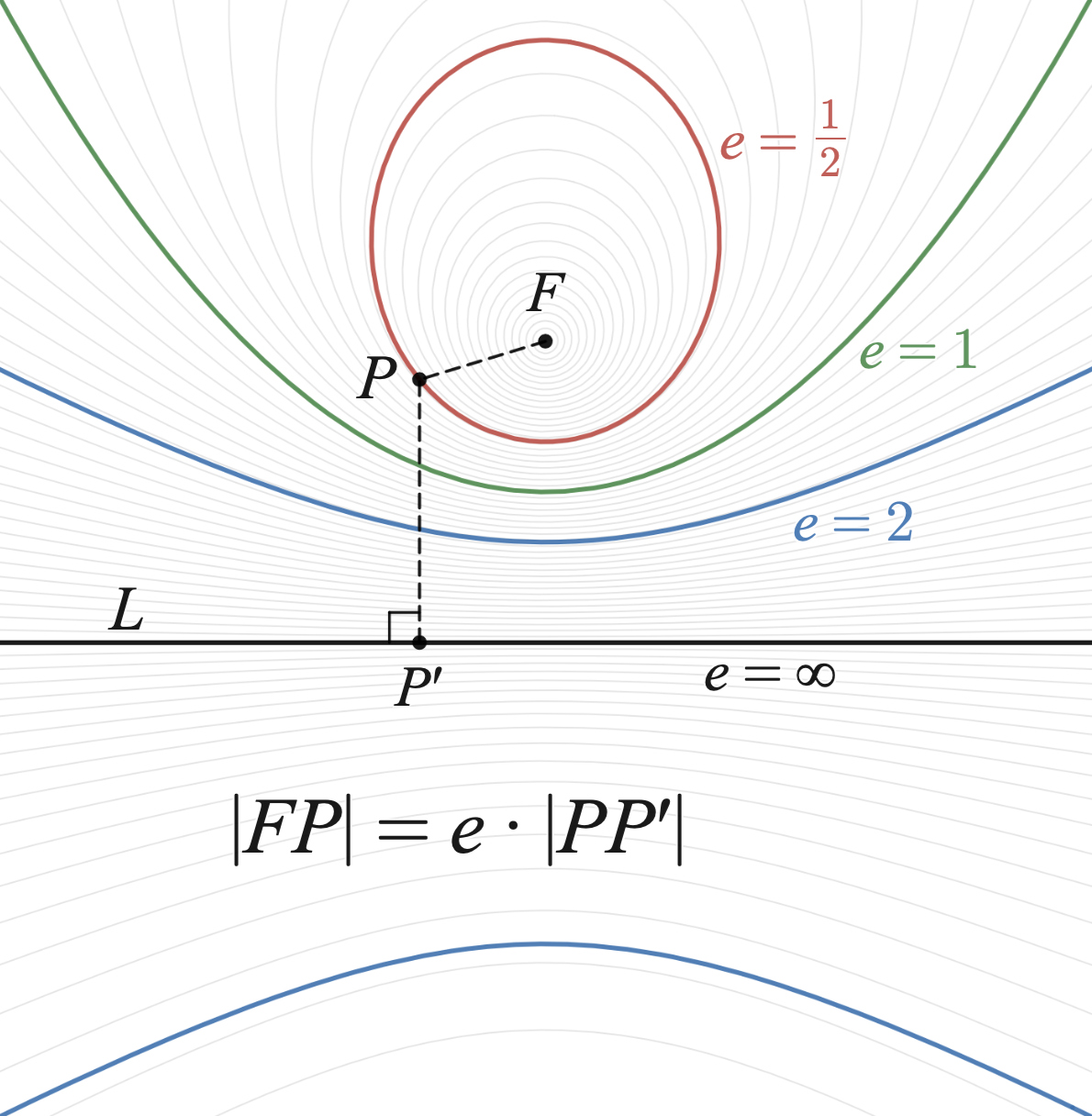
In math, we often use the letter "e" to represent eccentricity. The key thing to know is: if e = 0, it’s a circle! If e is between 0 and 1, we have an oval (ellipse). But when e is 1, we find a special shape called a parabola. And for e greater than 1, we have a shape called a hyperbola! 📏
In math, we often use the letter "e" to represent eccentricity. The key thing to know is: if e = 0, it’s a circle! If e is between 0 and 1, we have an oval (ellipse). But when e is 1, we find a special shape called a parabola. And for e greater than 1, we have a shape called a hyperbola! 📏
Read Less
Related Concepts in Geometry
Eccentricity is connected to other fun geometry ideas! 📏
For example, the focus and directrix are two key points related to conic sections and help define shapes like parabolas. We also have the terms "vertex" and "axis of symmetry," which relate to how conic sections look on a graph! By learning about eccentricity, kids can also explore other geometric concepts, creating a big exciting world of shapes and numbers! 🌟
For example, the focus and directrix are two key points related to conic sections and help define shapes like parabolas. We also have the terms "vertex" and "axis of symmetry," which relate to how conic sections look on a graph! By learning about eccentricity, kids can also explore other geometric concepts, creating a big exciting world of shapes and numbers! 🌟
Read Less
Mathematical Formula for Eccentricity
The formula to find eccentricity can change depending on the shape! For a circle, the eccentricity (e) is always 0. For an ellipse, we use the equation: e = √(1 - (b²/a²)), where 'a' is the long radius, and 'b' is the short radius! 📊
For parabolas, e is always equal to 1, while for hyperbolas, e = √(1 + (b²/a²)). All these formulas help mathematicians measure the "stretch" of the shape!
For parabolas, e is always equal to 1, while for hyperbolas, e = √(1 + (b²/a²)). All these formulas help mathematicians measure the "stretch" of the shape!
Read Less
Common Misconceptions about Eccentricity
Sometimes, kids think eccentricity only means being "weird" or "strange!" 🤪 In math, it specifically measures the shape of a conic section. Another misconception is assuming eccentricity is always a whole number; it can actually be any non-negative real number! Lastly, some may think higher eccentricity means a taller shape, but it really means it's stretched out, not necessarily taller! It’s important to clarify these ideas to understand this cool math concept! 😄
Read Less
Eccentricity and Shape of Conic Sections
Eccentricity helps us see how "round" or "flat" a conic section is! 😊
A circle is perfectly round, so its eccentricity is 0! As we move to an ellipse, its eccentricity tells us how oval it is: the more it stretches, the closer that number gets to 1. For a parabola, e is exactly 1, making it unique. Lastly, hyperbolas, which look like two curves, have eccentricity greater than 1 showing they are very stretched out! 🌌
A circle is perfectly round, so its eccentricity is 0! As we move to an ellipse, its eccentricity tells us how oval it is: the more it stretches, the closer that number gets to 1. For a parabola, e is exactly 1, making it unique. Lastly, hyperbolas, which look like two curves, have eccentricity greater than 1 showing they are very stretched out! 🌌
Read Less
Applications of Eccentricity in Real Life
Eccentricity isn’t just a math term – it appears in real life too! 🚀
For example, in astronomy, planets follow elliptical orbits around the sun, meaning they have a little eccentricity. This affects how fast they move! Eccentricity also helps engineers design roller coasters that twist and turn just right! 🎢
Even in architecture, it guides curves in bridges and buildings. So, eccentricity is helping us make cool things all over the world!
For example, in astronomy, planets follow elliptical orbits around the sun, meaning they have a little eccentricity. This affects how fast they move! Eccentricity also helps engineers design roller coasters that twist and turn just right! 🎢
Even in architecture, it guides curves in bridges and buildings. So, eccentricity is helping us make cool things all over the world!
Read Less
Graphing Conic Sections Based on Eccentricity
When we graph conic sections, eccentricity helps us draw them correctly! 📈
For circles (e=0), we draw a perfect round shape. To make an ellipse (e between 0 and 1), we stretch our circle a little. For parabolas (e=1), we create a “U” shape that opens either up or down. Hyperbolas are trickier! We need to make two arms that separate, showing greater eccentricity (e>1). Using equations, we can turn these ideas into pretty pictures on a graph! 🎨
For circles (e=0), we draw a perfect round shape. To make an ellipse (e between 0 and 1), we stretch our circle a little. For parabolas (e=1), we create a “U” shape that opens either up or down. Hyperbolas are trickier! We need to make two arms that separate, showing greater eccentricity (e>1). Using equations, we can turn these ideas into pretty pictures on a graph! 🎨
Read Less
Historical Context of Eccentricity in Geometry
Eccentricity has a rich history, finding roots in ancient Greece! 📜
The famous mathematician conic sections was used and studied by great minds like Apollonius of Perga around 200 BC! Over time, mathematicians like Johannes Kepler and Sir Isaac Newton continued exploring these shapes. Their discoveries helped us understand not only geometry but also the orbits of planets! 🌌
Thanks to their work, we now enjoy the benefits of eccentricity in both math and science!
The famous mathematician conic sections was used and studied by great minds like Apollonius of Perga around 200 BC! Over time, mathematicians like Johannes Kepler and Sir Isaac Newton continued exploring these shapes. Their discoveries helped us understand not only geometry but also the orbits of planets! 🌌
Thanks to their work, we now enjoy the benefits of eccentricity in both math and science!
Read Less
Try your luck with the Eccentricity Quiz.
Try this Eccentricity quiz and see how many you score!
Q1
Question 1 of 10
Next
Explore More