
Back
Present
Facts for Kids
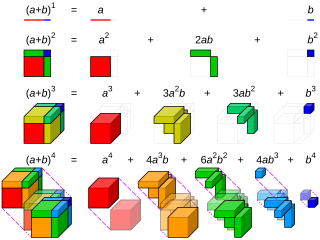
The binomial theorem provides a method for expanding powers of binomials, allowing for efficient calculation of coefficients in polynomial expressions.

Explore the internet with AstroSafe
Search safely, manage screen time, and remove ads and inappropriate content with the AstroSafe Browser.
Download

Become a Creator with DIY.org
A safe online space featuring over 5,000 challenges to create, explore and learn in.
Learn more
Overview
The Binomial Theorem helps us understand how to expand expressions like (a + b)ⁿ. It tells us how many ways we can choose different parts of our expression! For example, if we have (x + 2)³, we can find the result by multiplying it out. The theorem was discovered by mathematicians like Sir Isaac Newton and Blaise Pascal. 📚✨ It has cool applications in algebra, probability, and even in games! The theorem lets us work with powers in a simpler way and is super important for anyone who loves math. Let’s explore this fascinating topic! 🎉
Read Less
Common Misconceptions
A common misconception about the Binomial Theorem is thinking that it only works for whole numbers! 🛑
However, it works for fractions and even negative numbers too! Another misunderstanding is that students may confuse coefficients with terms. Remember: coefficients are the numbers in front, while terms are parts of the expression. Lastly, some might think it only applies in math class, but it’s everywhere in real life! 🌍
Understanding these differences helps clarify how useful the Binomial Theorem is in many situations! Let’s bust those myths together! 💪
However, it works for fractions and even negative numbers too! Another misunderstanding is that students may confuse coefficients with terms. Remember: coefficients are the numbers in front, while terms are parts of the expression. Lastly, some might think it only applies in math class, but it’s everywhere in real life! 🌍
Understanding these differences helps clarify how useful the Binomial Theorem is in many situations! Let’s bust those myths together! 💪
Read Less
Examples and Exercises
Let’s practice with the Binomial Theorem! 📘
For instance, expand (x + 3)². First, identify the coefficients from Pascal's Triangle: 1, 2, 1. So, (x + 3)² = 1(x²) + 2(3x) + 1(3²) = x² + 6x + 9! 🎉
Now, try expanding (y + 4)³. Remember, you can use the coefficients: 1, 3, 3, 1! Find the result and see how you did! Lastly, practice spotting coefficients in a few different expressions to get familiar with them. Math is a journey, and practicing helps us learn! 🚀
For instance, expand (x + 3)². First, identify the coefficients from Pascal's Triangle: 1, 2, 1. So, (x + 3)² = 1(x²) + 2(3x) + 1(3²) = x² + 6x + 9! 🎉
Now, try expanding (y + 4)³. Remember, you can use the coefficients: 1, 3, 3, 1! Find the result and see how you did! Lastly, practice spotting coefficients in a few different expressions to get familiar with them. Math is a journey, and practicing helps us learn! 🚀
Read Less
Further Reading and Resources
If you want to learn more about the Binomial Theorem, there are many fun resources! 🌟
You can read "Algebra for Kids" by William Dunham or explore online videos on math websites like Khan Academy! 📹
Websites like Coolmath4kids.com also have fun games and explanations. Libraries have books on math history, like "Mathematics: A Very Short Introduction" to see how the theorem fits into the bigger picture. Don’t forget to ask your teacher any questions you have! 📚
Exploring math is a wonderful adventure full of discoveries! Happy learning! 🎈
You can read "Algebra for Kids" by William Dunham or explore online videos on math websites like Khan Academy! 📹
Websites like Coolmath4kids.com also have fun games and explanations. Libraries have books on math history, like "Mathematics: A Very Short Introduction" to see how the theorem fits into the bigger picture. Don’t forget to ask your teacher any questions you have! 📚
Exploring math is a wonderful adventure full of discoveries! Happy learning! 🎈
Read Less
Proof of the Binomial Theorem
To prove the Binomial Theorem, we can use mathematical induction! 🤔
This means showing that if it's true for one number, it also holds for the next. First, we check that it works for n=1. Then, we assume it’s true for n=k and show it works for n=k+1. This involves rearranging terms and using coefficients from Pascal's Triangle. The exciting part is that this method confirms that each term in the expansion follows the pattern in the Binomial Theorem! Math can be like a puzzle sometimes, and proving theorems is one of its coolest parts! 🧩
This means showing that if it's true for one number, it also holds for the next. First, we check that it works for n=1. Then, we assume it’s true for n=k and show it works for n=k+1. This involves rearranging terms and using coefficients from Pascal's Triangle. The exciting part is that this method confirms that each term in the expansion follows the pattern in the Binomial Theorem! Math can be like a puzzle sometimes, and proving theorems is one of its coolest parts! 🧩
Read Less
History of the Binomial Theorem
The history of the Binomial Theorem goes back thousands of years! 📜
One of the earliest records was in ancient China, around 200 BC, where mathematicians explored similar ideas. However, it was Sir Isaac Newton in the 17th century who really made it famous! He published his findings in 1665. 🙌
Blaise Pascal, from France, created Pascal's Triangle, which helps find the coefficients (the numbers in front of each term) in the expansions. Today, we owe a lot to these clever mathematicians who helped us understand this theorem that is still used in classrooms worldwide! 🌎
One of the earliest records was in ancient China, around 200 BC, where mathematicians explored similar ideas. However, it was Sir Isaac Newton in the 17th century who really made it famous! He published his findings in 1665. 🙌
Blaise Pascal, from France, created Pascal's Triangle, which helps find the coefficients (the numbers in front of each term) in the expansions. Today, we owe a lot to these clever mathematicians who helped us understand this theorem that is still used in classrooms worldwide! 🌎
Read Less
Understanding Binomial Coefficients
Binomial coefficients are special numbers that show how many ways we can choose items from a group! 🧮
In the expression (a + b)ⁿ, the coefficients are found in Pascal's Triangle. For example, in (x + 2)³, the coefficients are 1, 3, 3, and 1. These tell us how many of each term there are when we expand the expression. The nth row in Pascal's Triangle shows the coefficients for (a + b)ⁿ. Understanding these helps us become better at solving math problems and understanding patterns! 🌟
In the expression (a + b)ⁿ, the coefficients are found in Pascal's Triangle. For example, in (x + 2)³, the coefficients are 1, 3, 3, and 1. These tell us how many of each term there are when we expand the expression. The nth row in Pascal's Triangle shows the coefficients for (a + b)ⁿ. Understanding these helps us become better at solving math problems and understanding patterns! 🌟
Read Less
Applications of the Binomial Theorem
The Binomial Theorem has amazing applications! 🎨
In probability, it helps calculate chances of events happening. For example, if you're flipping a coin, the theorem helps find the probability of getting heads or tails a certain number of times. 🎲
It’s also used in computer science for algorithms and coding. Plus, artists use it to create designs and patterns! The theorem is not just for math class; it appears in real life when you bake too! 🍰
If you mix different ingredients, the Binomial Theorem helps figure out how they combine!
In probability, it helps calculate chances of events happening. For example, if you're flipping a coin, the theorem helps find the probability of getting heads or tails a certain number of times. 🎲
It’s also used in computer science for algorithms and coding. Plus, artists use it to create designs and patterns! The theorem is not just for math class; it appears in real life when you bake too! 🍰
If you mix different ingredients, the Binomial Theorem helps figure out how they combine!
Read Less
Generalizations of the Binomial Theorem
There are many generalizations of the Binomial Theorem! 🤯
One cool one is the Binomial Series, which is used when we have powers that aren't whole numbers. This helps in more advanced math, like calculus. Calculus is the study of change and motion! Another generalization involves negative and fractional exponents, which also expand using the Binomial Theorem rules. These ideas are super useful for math wizards who want to tackle even more complex problems! 🌈
This shows us how the Binomial Theorem grows and connects to other branches of mathematics.
One cool one is the Binomial Series, which is used when we have powers that aren't whole numbers. This helps in more advanced math, like calculus. Calculus is the study of change and motion! Another generalization involves negative and fractional exponents, which also expand using the Binomial Theorem rules. These ideas are super useful for math wizards who want to tackle even more complex problems! 🌈
This shows us how the Binomial Theorem grows and connects to other branches of mathematics.
Read Less
Try your luck with the Binomial Theorem Quiz.
Try this Binomial Theorem quiz and see how many you score!
Q1
Question 1 of 10
Next
Explore More